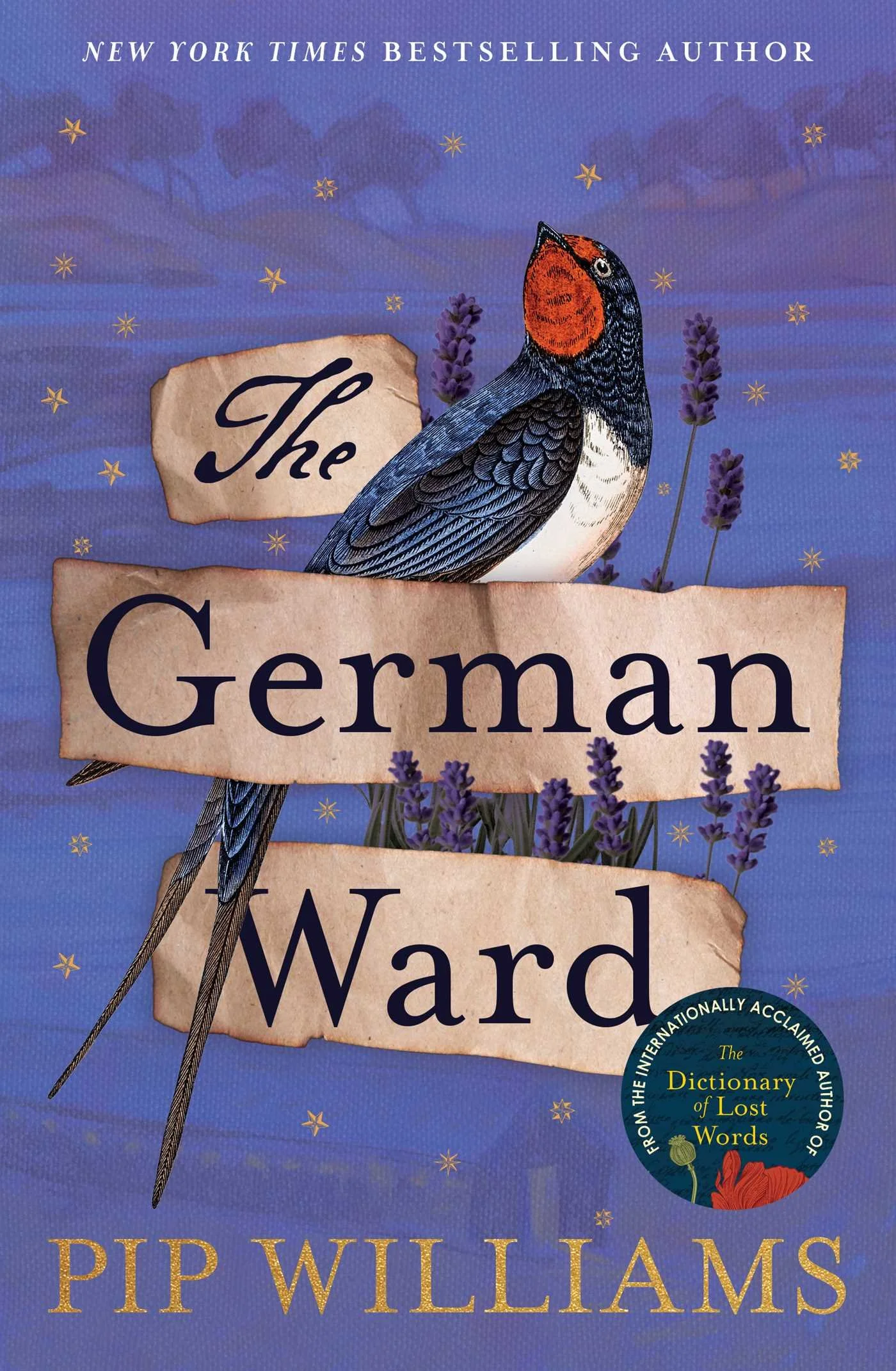
By Pip Williams
Recommended by Kerry
Pip Williams is the author of the award-winning novels, The Dictionary of Lost Words and The Bookbinder of Jericho. Both novels are set in Oxford, England, with the women's suffrage movement and World War 1 looming in the background.
In The German Ward, Tilda Taylor, a free-taking actress, and one of Emmeline Pankhurst’s suffragette activists in the earlier novels, becomes the central character. Tilda is now a VAD (Voluntary Aid Detachment) nurse on the front lines, in Étaples, France and she brings the horrors of World War 1 to the centre of the novel.
Étaples was the largest Army base of the war, serving British, Canadian, Scottish and Australian forces. It was a training ground; a supply depot; a detention centre for prisoners and the location of several large hospitals for the wounded from the Somme battles.
Tilda works in both the hospitals where injured Allied soldiers are brought, and the German Ward, where the irony of treating and possibly saving the lives of German soldiers, who the Allies were so recently attempting to kill, is not lost on her. These shattered, suffering men are simply humans who need help.
Another irony is that the German prisoner, Dr Henning, roughly handled and brought to the Ward each day by Allied soldiers, is integral to the operations of the German Ward.
Tilda befriends Iso Rae, another VAD, who lives in Étaples. The character of Iso is based on the real-life Australian artist, Iso Rae, who became one of only two Australian women artists to document the war in France. Despite not being an official war artist, Iso quietly documented the Étaples Army Base Camp through at least two hundred drawings which depict everyday life in the camp.
Some of these drawings are now owned by the Australian War Memorial (see part of that collection here). Tilda’s story is framed by the narrative of a contemporary archivist in the Australian War Memorial archives to research the work of Iso Rae. This is where Pip Williams discovered the work of Iso Rae, and the kernel of this novel sprang.
Pip Williams examines the aftermath of war through the prism of Iso’s drawings, interlinking the feminine with the masculine, art with war, horror with tenderness, friendship, and even love.
This is a powerful novel, and while the links with Pip’s earlier novels are interesting, this novel stands alone.
4th Estate, 2026